 Boa Tarde,
I'm writing to you as a listener of the Radio Nacional da Amazônia shortwave service with concerns, comments, and feedback that I hope you will take under serious consideration. I also come before you as a radialista from the United States with experience not only in programming, but also in the financial and technical aspects of radio broadcasting.
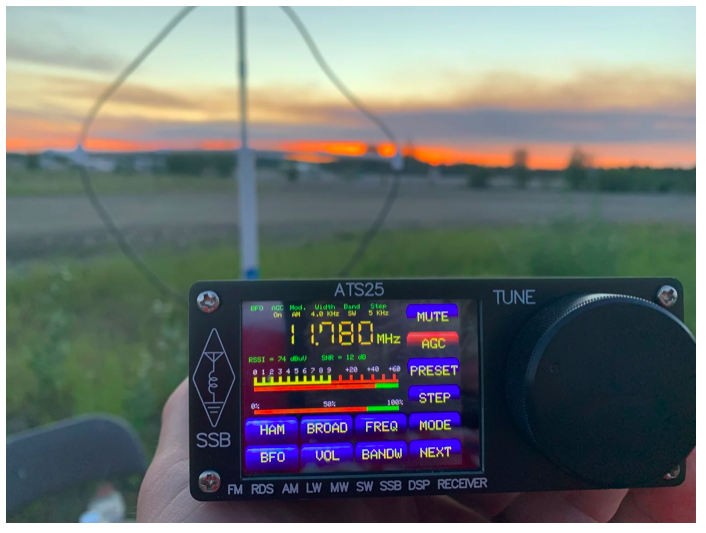
I discovered the Radio Nacional da Amazônia shortwave service on 11780 kHz and 6180 kHz about six years ago while living in Alaska. I was born in the United States and only speak English, but I was immediately drawn to what I heard on the radio despite not understanding the language. The signal was often BIG, STRONG, AND CLEAR.
I was first drawn to the very lively and exciting futebol matches. You don't have to understand Portuguese to get excited when the announcer yells "GOAAALLL" and holds that scream for nearly 20 seconds. That's a moment and a level of excitement that isn't held back by a language barrier.
Then I discovered Mauricio Rabelo.
Again, I didn't know the language, but I was immediately drawn to the friendship and connection Mauricio shares with his listeners, and the connection they return to him. Listeners clearly enjoy and respect Mauricio, and despite his stature as a radio personality, they think of him as one of them—a regular guy.
I have become a very regular listener to Mauricio's show and have even contributed through WhatsApp voice messages. Because Mauricio has openly said his English is not very good, I have learned several Portuguese phrases and expressions to use alongside my English so that Mauricio and the listeners have a basic idea of what I'm saying, even if they don't understand every word.
Over time, I've heard listeners express genuine delight with my participation in the show, with some commenting on and even complimenting my use of Portuguese. Some have even invited me to visit Brazil.
I have continued participating because, despite the language barrier, I am made to feel welcome—like part of the family.
Mauricio is a wonderful ambassador for the radio station, and in return, the station is a wonderful ambassador for Brazil.
Because of Radio Nacional da Amazônia, I have even made two new friends. Mauricio connected me with a Brazilian expatriate living in Florida and a gentleman outside Brasília who works for a bank. I regularly talk with both of them on WhatsApp, and we've exchanged countless conversations, stories, photographs, and videos. Those friendships have only deepened my interest in Brazil and its people.
I have also been fortunate to connect with Manoel Caetano in the engineering department. He has always graciously answered my questions whenever there have been technical problems affecting the shortwave service.
Radio Nacional da Amazônia may have been created as a service for the Amazon region of Brazil, but in many ways it has become a world service. It is Brazil's voice reaching listeners around the globe. The signal is regularly heard throughout the United States, Canada, and Europe with little difficulty, and I have even heard recordings of the station being received in Japan and other parts of Southeast Asia.
The shortwave service gives people an opportunity to hear Brazil, develop an appreciation for the country, and form a genuine connection with it. I know many listeners here in the United States greatly value that connection.
I recently became aware that the shortwave service has had to reduce its operating hours because of technical issues and rising energy costs. As a radialista in the United States who also understands the technical and financial realities of operating a radio station, I completely understand the difficult situation Radio Nacional da Amazônia faces.
Operating shortwave transmitters that are probably 50 years old is neither easy nor inexpensive. They consume tremendous amounts of electricity and are far less efficient than modern transmitters, meaning they require even more power to operate. With aging equipment also comes an increase in technical and mechanical problems that become both time-consuming and expensive to repair.
While many of us in the United States can listen online through streaming, it simply isn't the same. There is something nostalgic and exciting about tuning in to Radio Nacional da Amazônia over shortwave from thousands of kilometers away.
Unfortunately, the reduced operating schedule makes Radio Nacional da Amazônia almost unlistenable for many of your loyal listeners in the United States.
With the current schedule, 11780 kHz signs off before propagation becomes favorable enough for a good signal in the United States. The station signs off at 2000 UTC, but it generally isn't well received in the eastern United States until around 2200 UTC. In the western United States, the signal usually doesn't become truly usable until around 0000 UTC.
Meanwhile, 6180 kHz remains very weak and noisy across much of the central and western United States because we still have so many hours of daylight during the summer months. It may provide a decent nighttime signal in the eastern United States, but by the time it becomes listenable in the western United States, it is very late in the evening. This situation will continue for several more months because of seasonal daylight.
Even during the winter months—from roughly October through December—11780 kHz will still only provide good reception in the eastern United States before signing off at 2000 UTC. The western United States will continue to have little or no usable signal before the transmitter leaves the air. While 6180 kHz will become more usable in winter, it does not fully replace the excellent coverage that 11780 provided.
Before the schedule change caused by technical issues and energy costs, 11780 kHz remained on the air until 0200 UTC and provided an outstanding signal throughout the United States.
How outstanding?
At my location in southeastern Wyoming, it often sounded nearly as clear as a local FM station.
Here is a recording I made in March 2026 demonstrating just how strong the signal was:
https://drive.google.com/file/d/1EITXW7O01I2bWG_B3hdvQJtk73tcVZQM/view?usp=sharing
I would respectfully ask that those responsible consider restoring the 11780 kHz schedule to a 0200 or 0300 UTC sign-off. Perhaps it may not be possible seven days a week—I completely understand the financial realities—but perhaps it could be restored two days each week, such as Fridays and Saturdays to allow your USA and Canadian listeners to enjoy listening to Radio Nacional da Amazonias Shortwave after a week of work, giving us a chance to relax on Fridays & Saturdays to the wonderful soudns coming from Brazil on the radio
Doing so would once again provide the exceptional service to listeners in the United States that so many of us have come to appreciate and depend upon.
Of course, my hope would be for a full seven-day restoration of the original schedule. However, if that simply isn't possible, I believe that restoring the extended hours just two days each week would be a reasonable compromise that would still allow many of your international listeners to enjoy Radio Nacional da Amazônia as they once did.
Without restoring the extended hours of 11780 kHz for at least part of the week, many listeners in the United States will continue to be left without a reliable, high-quality shortwave signal from Radio Nacional da Amazônia.
Please know that this letter comes from a place of admiration, not criticism. I care deeply about this service and what it represents—not only to the people of Brazil, but also to listeners around the world. It has introduced me to your country, your culture, and your people, and I sincerely hope to see it continue to thrive for many years to come.
I welcome any questions or discussion with members of the Empresa Brasil de Comunicação staff and would be happy to speak further about my observations as a longtime listener. I can be reached using the contact information below.
Thank you very much for your time and consideration. I eagerly await your response and hope this letter can begin a fruitful discussion. I know I speak for many of your Radio Nacional de Amazonias shortwave listeners when I say we would all be thrilled with at least a partial restoration of broadcasting hours for 11780khz