 Back when I was a early teenage radio listener, my radio of opportunity had 5 vacuum tubes, a scarcely calibrated dial, illuminated by incandescence, audio with the warmth of a winter glove and the ability to ascertain an accurate frequency commensurate with the times - which is to say: Not at all precise!
In the early 1970's one developed a certain muscle memory with their radio. For instance, Radio Netherlands via Bonaire in the sunny Caribbean held court on 6165 Khz. HCJB in Quito, Ecuador appeared nightly, reliable as gravity, on 9560 Khz. The Northern Service of CBC Radio was on 9625 Khz and others.
A crafty and somewhat nerdy youngster like me quickly created a reference list of where everyone was on the dial, locking down the frequency purely by station identification and keying it into my muscle memory. If anything, these were the best of times. Like any new hobby, the technical prowess was low and the excitement of discovery was high.
By mid-decade, for me, tubes were replaced with transistors and the occasional analog integrated circuit. Digital read-out and frequency synthesis was still a few years away.
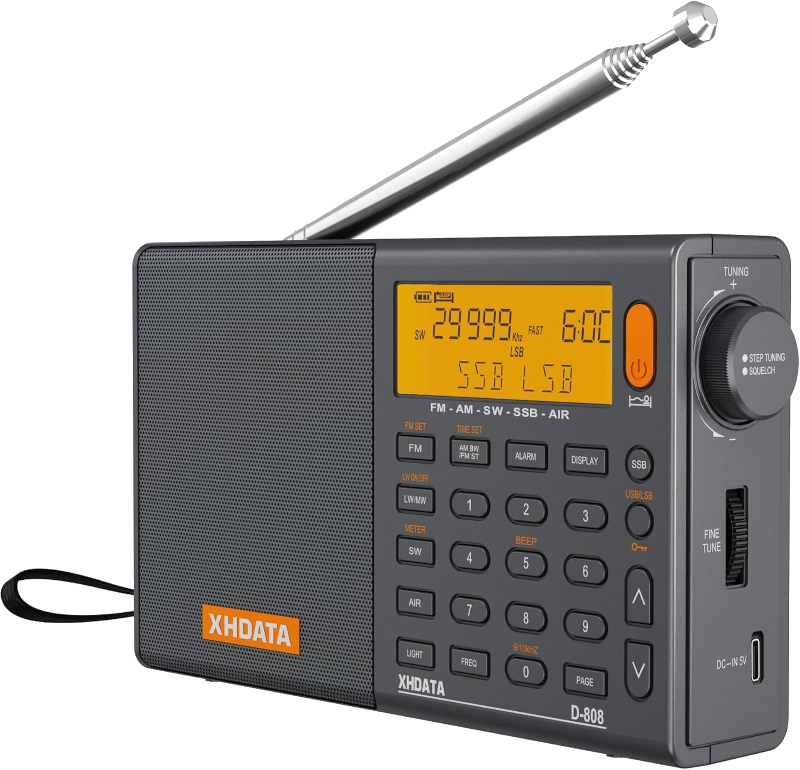
Fast forward 4 decades and we now have ultra-light portables like the XHDATA D-808.
At 310 grams with battery and dimensions of 14.5 x 8.7 x 2.7 cm (just fitting in my manly-man palm...) this is a high performance product that could discretely fit any sized carry-on bag, pack-sack, or shoulder-holster camera bag.
Let's glance at the coverage:
Frequency range
* FM: 87.5 – 108 (64-108) MHz
* LW: 150 – 450 kHz
* MW: 522 – 1620 kHz (9k Step) 520 - 1710 kHz (10k step)
* SW: 1711 – 29999 kHz
* AIR: 118 – 137 MHz
This is comprehensive - and while results may vary by country visited, I'd likely not advertise the fact that it can tune in aircraft as an overly zealous border guard may see this as "suspicious". Err on the side of caution and refer to it as an AM-FM radio.
In addition to solid AM(LW) and FM performance, the Shortwave capability is impressive - and it includes SSB (single sideband) functionality for ham radio, high frequency air band-aero weather, marine activities, more code and other neat things.
And while the XHDATA D-808 does not feature a dedicated Synchronous Detection (Sync) mode. Instead, it uses Single Sideband (SSB) with selectable Upper Side Band (USB) and Lower Side Band (LSB) to achieve the same result (if you know what you are doing...)
The XHDATA D-808 has 500 "memories" -- referred to as "pages" in the manual and user reviews. One can populate the memories manually or with an ATS system. The ATS is useful for capturing all your local FM stations and nesting them accordingly. Using ATS for evening AM or LW reception: maybe not so practical. You either love it or you don't.
The XHDATA D-808 has an internal rechargeable battery - charged by virtually any USB capable wall-wart... so, it can get a top up just about anywhere!
Hands on...
Moving between shortwave or "HF" meter bands is pretty streamlined: Press SW to move to the last visited SW meter band and then SW button repetitively to shutter between specific SW bands by increasing frequency.
For the "medium-wave" enthusiasts among us, the XHDATA D-808 has an internal ferrite rod antenna - great for sniffing out weak signals, useful for direction finding and easily coupled to larger loop or active antennas.
The XHDATA D-808 has an 1/8" antenna jack that works well with all active and passive wire antennas - balanced or unbalanced... ultimately extending the range of the radio in many ways. And by the way, if I use any terminology that is not immediately clear, by all means hit me with an e-mail for a more detailed explanation!
Display matrix - some folks complain about the display, its real estate and the overall layout with focus placed on the amount of pixels dedicated to frequency. The frequency display gets around one quadrant of the overall display -- that is 1/4. Fine for me. Mileage will vary by how sharp your eyes are. The top left of the display is dedicated to frequency. The upper right is a 4-mode display function; Time, alarm time, air temperature and signal strength in dbu and s/n ratio... super nerdy and useful! What for you ask? Being able to interpret the signal level is useful in evaluating signal strength station to station, tuning up or testing an antenna... direction finding and so on.
Conclusions...
Compared to where I came from, historically, this would be a dream radio in any decade beyond the 1950's until present. As mentioned, my 1965 radio contained 6 to 8 transistors and a very coarse analog display -- and yet I could hear stations over 1000 miles away at night. The XHDATA D-808 is no different. No less sensitive. Full featured and a heck of a lot of fun for the dollar. Some people say, "But Colin, the shortwave dial is dead -- and no one is on AM radio anymore!" Even if you live on the West Coast of North America, often considered the "fringe area" of HF/SW radio reception, most mornings around sunrise can be spectacular with stations from South, Central and East Asia clogging the dials with neat music and languages. The XHDATA D-808 is maximum bang for the buck. It is very discrete and readily tossed into an overnight bag or carry on. You needn't ever be without local or regional news!
The XHDATA D-808 is a must have for any radio enthusiast. It also has a home in every emergency kit. I cannot stress this enough: Keep a battery powered radio in your emergency pack along with a first aid kit, water and food stuffs, etc. The XHDATA D-808 radio is the perfect radio to always have within arms reach! Stay safe, listen in, have fun...
Colin Newell is a resident of Victoria B.C. on Vancouver Island - floating out in the Pacific. His blog has been on the air since the late 1990's and he enjoys talking on the subject of popular and food culture!